The Badge
Before the badge
He did not go from a military college straight into a police uniform. There was a whole industrial career first, and no published account of him mentions any of it.
After PMC he trained at Sayford Paper Specialty Products in Buena Vista, Virginia, then came back to Watertown, Connecticut as plant manager of a multi-million-dollar printing division — the one that made every Howard Johnson place mat and every Whitman Candy liner, and work for thousands of other companies besides. When that company closed he was hired as general manager at Schick Safety Razor. Then TRW offered him a position as purchasing manager, and he took it.
There he studied a then-new method for cutting the cost of buying maintenance and repair items, called System Contracting, and opened his first company to sell it to large firms, working with Mersick Super Supply in New Haven. That is where the cutting-tool expertise came from that Kyocera would later come looking for.
The badge
In 1965 he joined the State Police. Two years later he moved to Plainville.
From April 1967 to July 1976, nine years and four months, Graham Nicholson was a police officer with the Plainville Police Department. He went through the Connecticut Police Academy in 1970. His duties are listed in two words that are easy to skim past and shouldn't be: routine police duties, and firearms instructor.
The Courant confirms the span independently, in a single clause dropped into a 1992 story about karaoke. He makes more money now, the paper noted, than he did as a company vice president, or as a police officer, a job he had in Plainville for nine years.
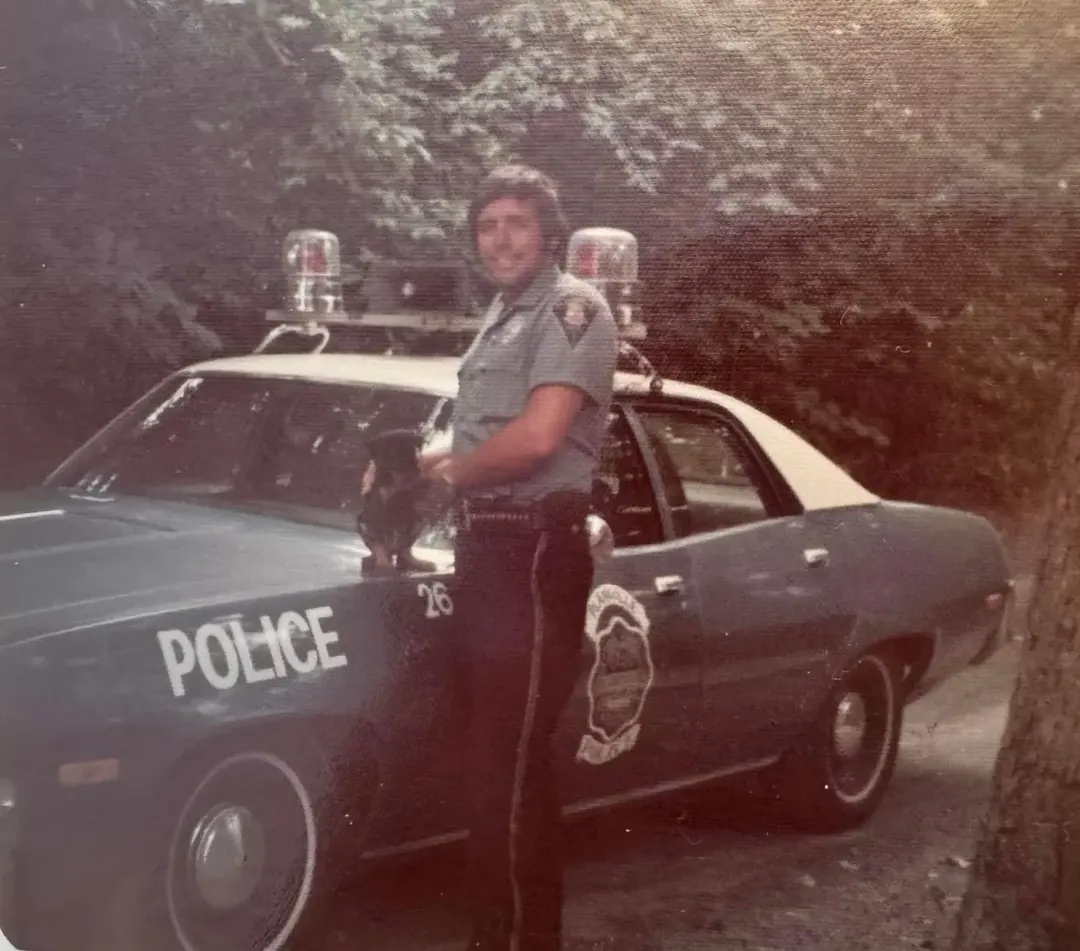
That is the entire published record of a decade. What survives from it in the archive is one photograph: Graham beside cruiser 26, in uniform, holding a puppy.
The guitar never went away in these years — the bands kept working the weekends — but those nights belong to the music chapters, and that is where their photographs now are.
It is worth holding the two lives together, because the rest of his makes more sense with both in frame. The man who would spend forty years running rooms full of strangers with microphones in their hands learned crowd control somewhere.
The Great Northern Route
And there is what he did on his time off, which he recorded himself and which nobody ever printed.
In 1973, while still on the department, he bought a 22-foot Penn Yan and took it on the Great Northern Route. Up the Hudson to Lake Champlain, on to St John and the Richelieu River, into the St Lawrence Seaway, down through the Eisenhower and Snell locks — a forty-five-foot drop — into Lake Ontario, across to the Mohawk Barge Canal, back into the Hudson, and home.
Roughly a thousand miles of river, lake and lock, in a 22-foot open boat, on a town policeman's holidays. The boats have their own chapter, and this is where they start.
January 1976
In 1973 he married Sandy Levesque.
In January 1976 she was killed in an automobile accident, and he was called to investigate it.
He wrote that sentence himself, in his own account of his own life, and it is set down here as he set it down, with nothing added to it.
In July 1976 he resigned from the Plainville Police Department.
After
He was hired in charge of security at Middlesex Hospital in Middletown.
A few months later Jack and Maureen Roberts asked him to move their 85-foot motor-sailer, the Lady Maureen, to Palm Beach, Florida — and the next part of his life starts there, on the water.