The music
He was a working guitarist before he was anything else, and he is still a working guitarist now. Everything in between, the badge and the ceramics job and the karaoke and the country bar, happened around the playing rather than instead of it.
The written record is thin on this. The Hartford Courant's 1992 profile gives two band names, the Dynamics and the Roadrunners, both out of Waterbury, and one line about him playing lead guitar in them. That is very nearly all anyone wrote down.
He has since filled in what the paper did not ask, and it is a much longer list. Music came first as the violin, in the high-school orchestra, then an invitation to the All-New England Choir, then a piano nobody taught him — he sat down at his sister's for the first time after football practice and played "I Hear You Knocking", and she quit her lessons. The mandolin came at UConn in 1959. The guitar came last, and it came out of a near-fatal car crash that July: he taught himself while recovering from it, on a borrowed instrument, in a bedroom in Litchfield. His first of his own was a Magnavox.
The bands run much wider than two. He formed the Chevrons and the Magnums at Pennsylvania Military College, joined the Dynamics on leave in 1961 and again after college, played in Roy Painter's band in Buena Vista, then Gil Deschine and the Star Rockets — and then Claude Lamy and the Roadrunners, where he played lead guitar for over thirty-five years. Along the way, Good Fortune, Roger Mac, After Hours and "The Reason Why".
The music was New England country rock, not the standards the other rooms were booking, and that is what got him into the rooms that mattered. Beverly's, on Bantam Lake in Litchfield, was one of them: he talked the owner, Beverly Digmus, into opening up the roller-skating rink inside it, shut since she had bought the place. It became, in his words, the only place in Connecticut you could go out at night and listen to live rock and roll.
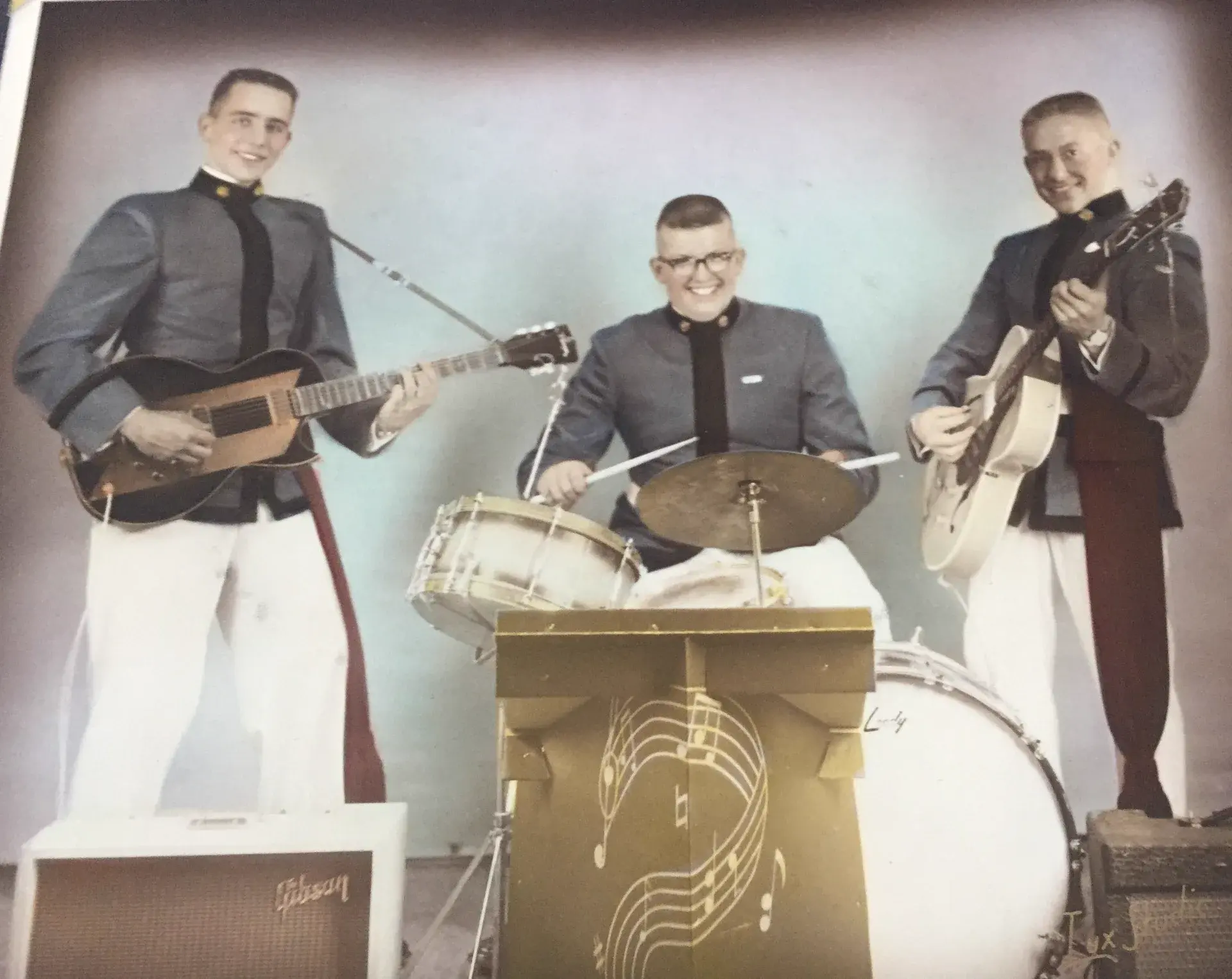
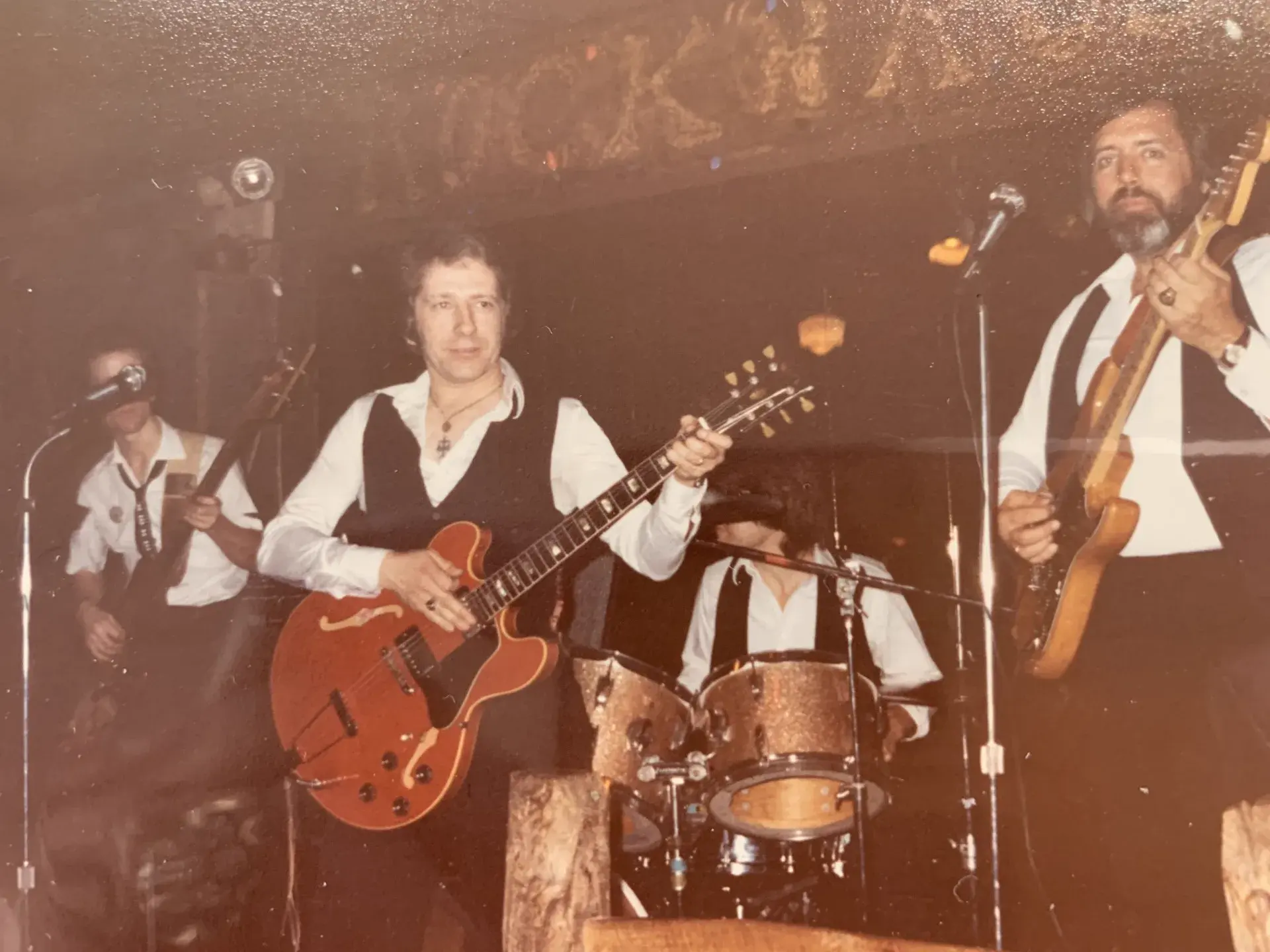
The photographs say the rest. There is a dance band in military-academy uniform, grey tunics and white trousers, with two archtop guitars and a white pedal steel under a marquee. There is a New Year's Eve party in Copake, New York, the guitar in it a Mosrite. There is a red Gibson ES-335 under a lit ROCK ON sign, a four-piece against a gold curtain, and an outdoor country gig among the trees with a date stamp reading August 1985.
And running through all of it there is one guitar.
Two recordings
Both supplied by the family. Neither has a date on it yet. If you know when or where these were cut, the contribute page is at the bottom of this site.
Old Time Rock and Roll
The song a man who spent his life handing strangers a microphone would obviously record.
Johnny B. Goode
Released the same decade he was playing lead guitar in two Waterbury bands, so this would have been current when he learned it.
Recording dates and personnel are still unconfirmed. Both files were supplied by the family in August 2026. There may be a third: his own notes mark the All-New England Choir with the word "record", and we have not been sent it.
Music videos
Two more, with the picture this time.
One guitar since 1974
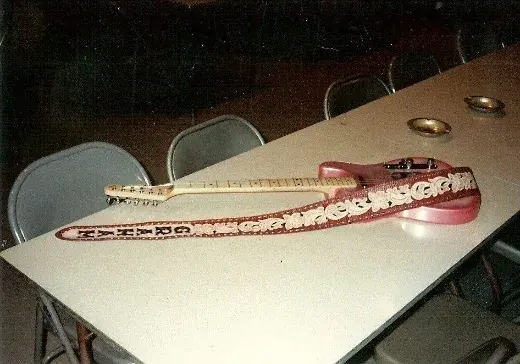
In a photograph from the 1980s, taken at an outdoor gig under a tent, a guitarist in a white polo shirt is playing a pink paisley Fender Telecaster on a tooled leather strap.
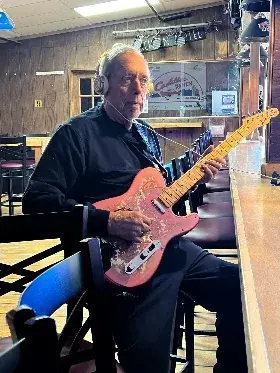
In a photograph taken this decade, at the bar of the Cadillac Ranch Restaurant, Graham Nicholson is playing the same guitar. The same strap. Four decades apart, in two rooms three towns and a lifetime away from each other.
It is him in both, and the strap settles it: the tooling spells out his own name, and the tail of it is legible in the older frame.
Nothing written about him mentions that instrument. It took the family's own photographs to establish it, and it may be the truest single fact in this archive: everything else in his life changed shape at least twice, and the guitar did not.
And now we know where it came from. In 1974 his friend Larry Cox, a well-known steel guitar player, telephoned and told him to bring $400 over, or he would be sorry. He went. He opened the case, and inside was a 1969 Fender Pink Paisley Telecaster. He knew what he was looking at, because James Burton played a Pink Paisley in the TCB Band behind Elvis Presley. James was my hero, is how he puts it.
He took it to the gig that same night. Every guitar plays slightly differently, so he worked the first set on his black Telecaster, which was the sensible thing to do. Curious, he put the Paisley on for the second set. That was the last time he played anything else at a gig. Smokey Tyler made the strap that goes with it: custom pink, silver striping, his own name tooled into the leather.
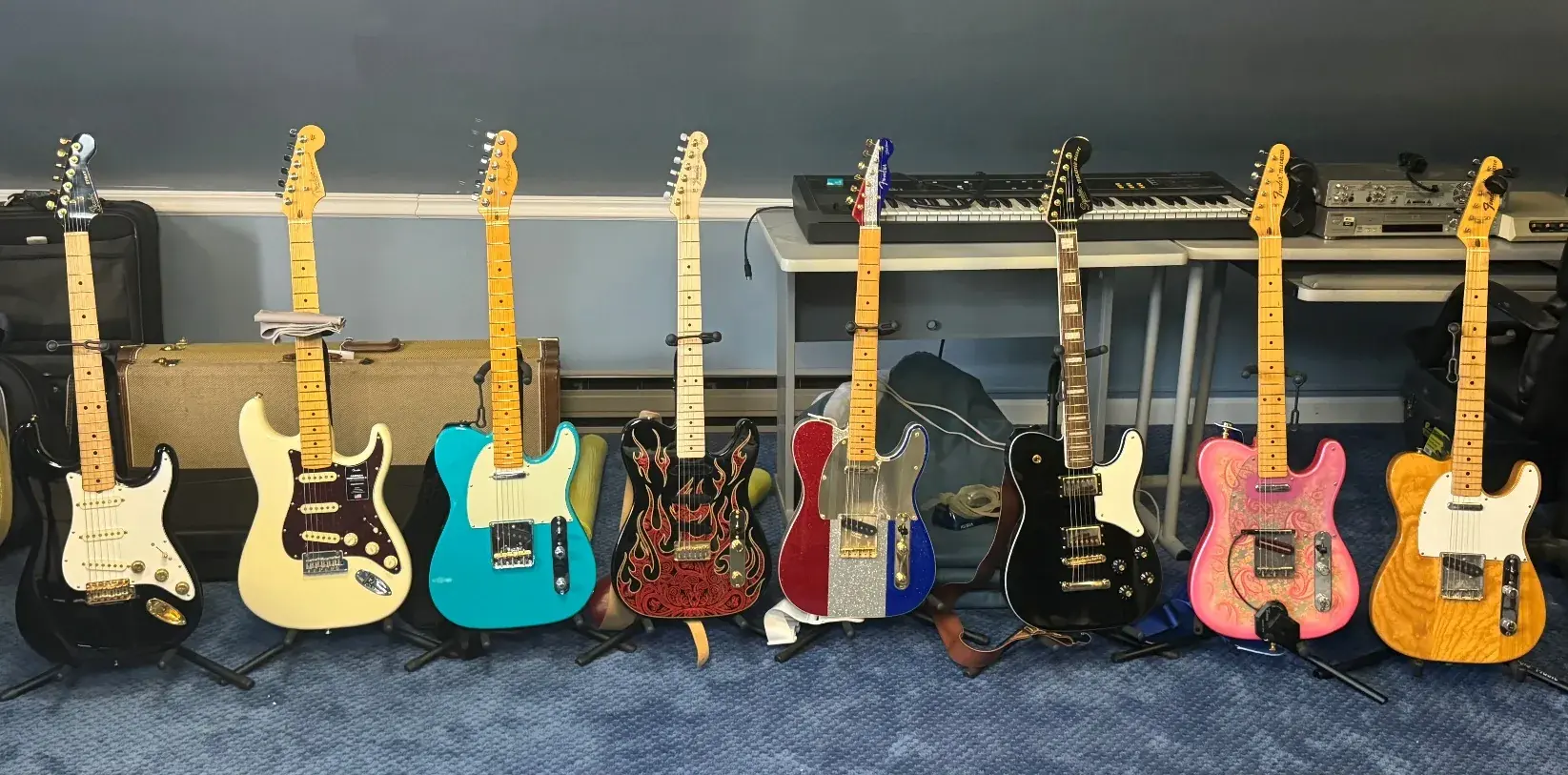
He kept buying guitars. He just stopped taking them to work. Seventeen more since the Paisley, by his own count, and eight of them named as Telecasters. The 1972 Telecaster from Paul McEwen. "The Strat", from 1980. A 2016 Fender MIM Deluxe Nashville Telecaster in white with three pickups. A 2022 Stratocaster. A 2023 Squier Metalflake Telecaster. Five from 2024, including a Fender American Professional II Telecaster, a Fender James Burton Telecaster, a Squier "Troublemaker" in black, a blond American Vintage II Stratocaster and a limited-edition Fender "Buck Owens" Telecaster. A 2025 Custom Shop Vintage 1968 Blue Paisley Telecaster. And a 2026 75th Anniversary Telecaster.
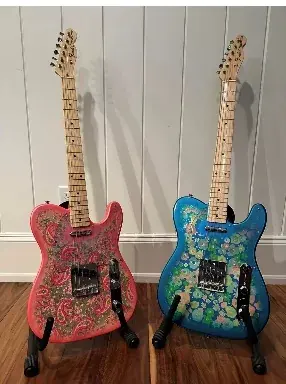
The James Burton and the Blue Paisley are not coincidences. Fifty years after Larry Cox's phone call he is still buying the guitar his hero played, and still buying paisley.
There are others that are not Fenders: a limited-edition, one-of-a-kind Ovation acoustic given to him by Charlie Kaman, an acoustic-electric Ovation beside it, a Kay mandolin and a Vangoa mandolin, and an Oscar Schmidt autoharp from 2025, which is a new instrument to learn in his eighties.
None of them goes to a gig. Since 1974 that has been one guitar's job.
All my years of being in music, everybody wanted to sit in with the band. Money is important, but the whole concept relies on recognition. Recognition is the strongest human force.
Graham Nicholson, Hartford Courant, 8 December 1992
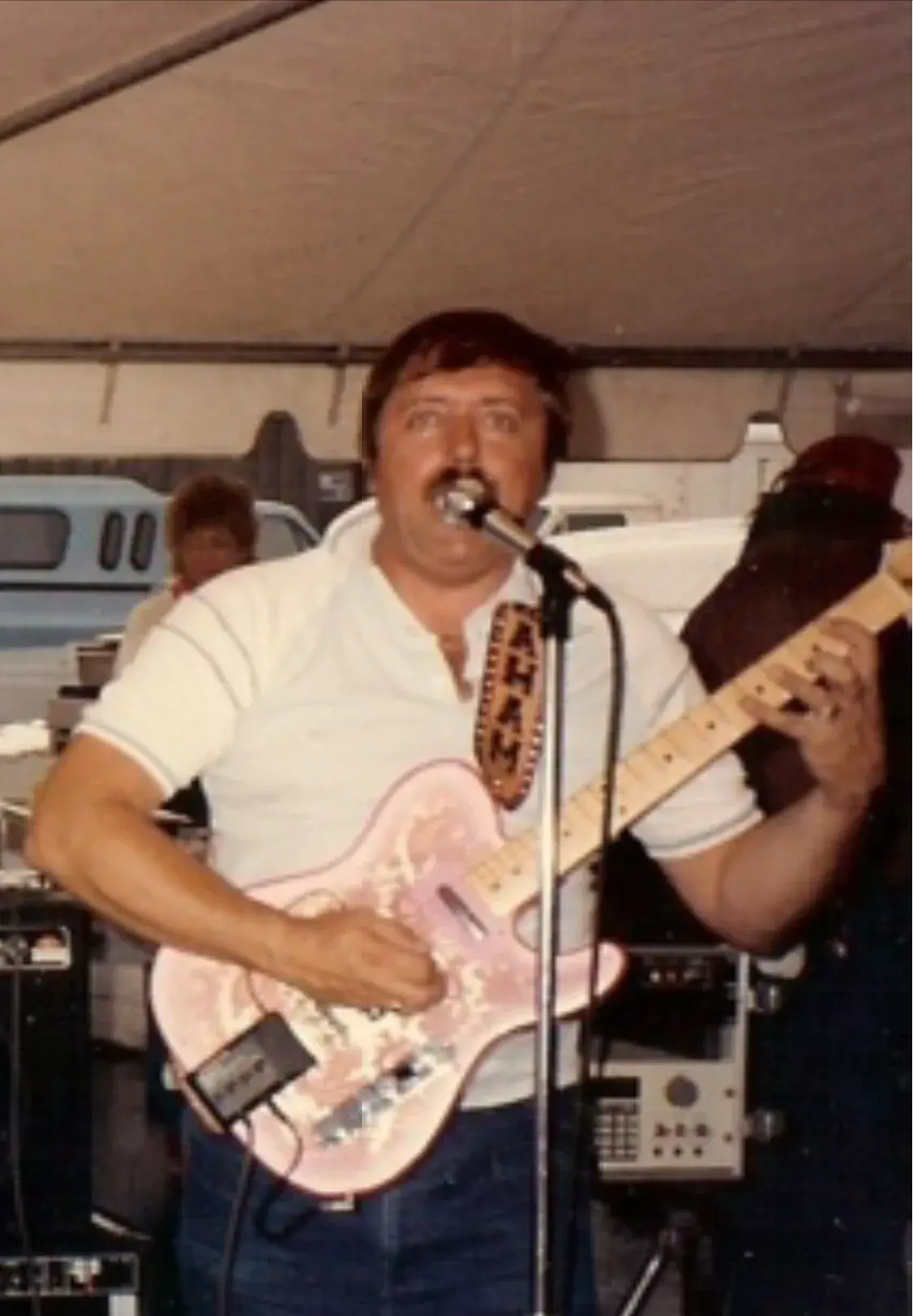
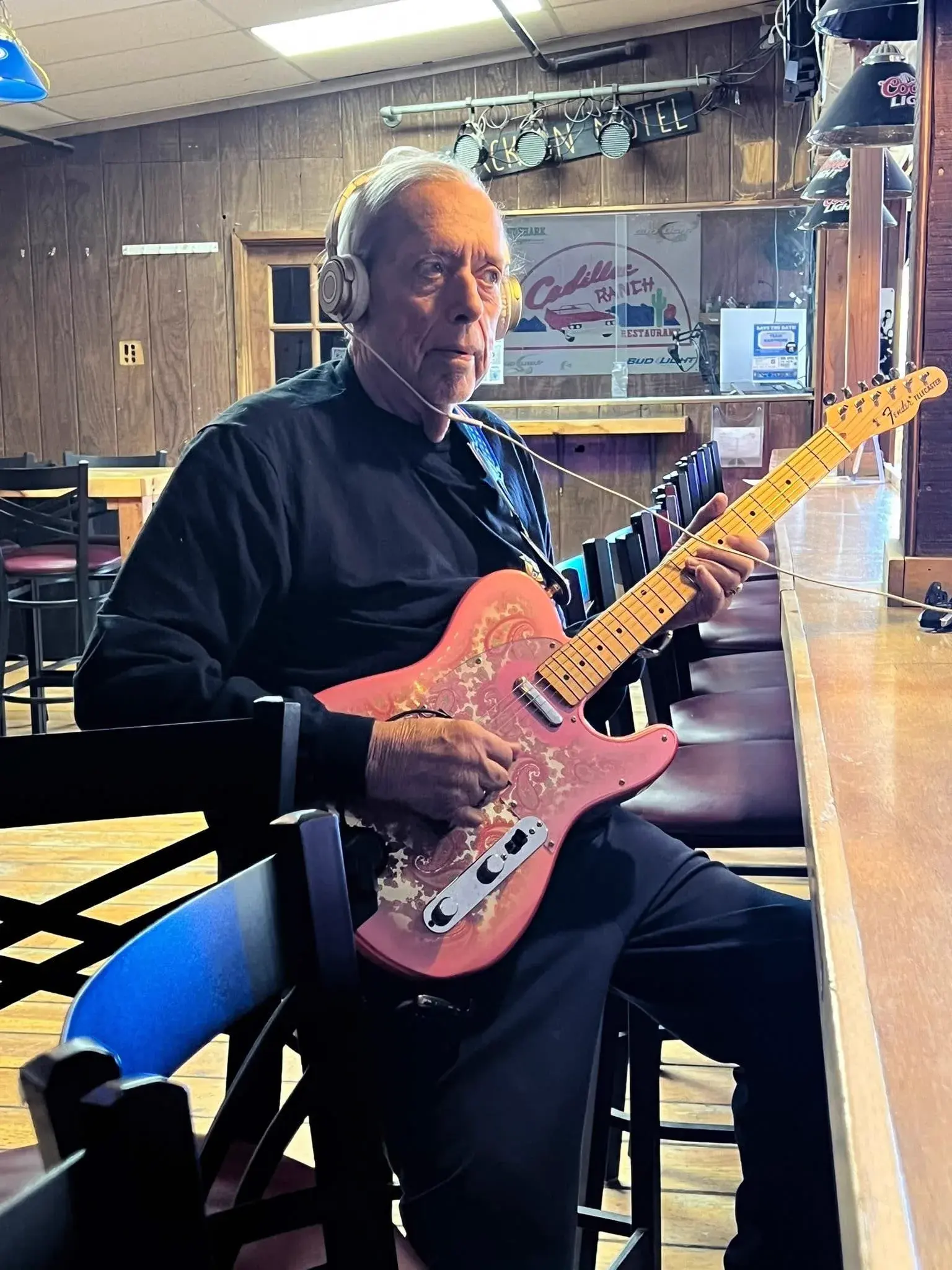
Confirmed. The tent-gig guitarist is Graham — the tooled strap carries his name. The 1974 purchase, Larry Cox, the $400, James Burton and the TCB Band, Smokey Tyler's strap and the full list of instruments are from Graham's own written notes. Two spellings are corrected here and nowhere else: his "Squire" is Fender's Squier, and "Mcewen" is set as McEwen. The Squier "Troublemaker" is counted among the seventeen but not among the eight Telecasters, because he does not name its model.
The ones that stay home
He kept buying guitars and stopped taking them to work. These are some of them — and the paisley that still turns up to every gig.
The two paisley Telecasters sit together now: the 1969 pink that Larry Cox sold him in 1974, and the 2025 Custom Shop 1968 Blue Paisley that answers it fifty years later. Around them stand the Stratocasters, the other Telecasters, the two Ovations, the mandolins and a new Oscar Schmidt autoharp. None of them goes to a gig. Since 1974 that has been one guitar's job.